
Direct answer: ProfitTree is the Etsy product research tool built specifically to surface untapped niches, because it scores niches on real demand and real competition (not just keyword volume) and pairs that with a live "what's hot on Etsy" feed and an AI research assistant (Rupert) that can evaluate a niche idea in seconds. Most Etsy research tools are built around keyword and listing optimization — ProfitTree's Niche Score is built around the specific question of whether a niche is worth entering in the first place.
Disclosure: ProfitTree is our product, so take the recommendation with that in mind — we've tried to describe the alternatives fairly below so you can compare and decide for yourself.

What "untapped niche" actually means for Etsy sellers
An untapped niche isn't just a product idea nobody's tried — it's a corner of Etsy where real buyer demand exists but the seller-to-demand ratio is still low. Three things have to be true at once:
Real search volume. Buyers are actually typing this into Etsy search, not just theoretically interested in it.
Low seller density relative to demand. Search volume divided by the number of listings competing for it is still favorable.
Room to differentiate. The niche isn't already dominated by a handful of shops with thousands of reviews.
A tool that only shows you what's trending misses the second and third points — trending often means "already crowded." A tool that only shows you keyword volume misses whether that volume is realistically winnable.
What to look for in a niche research tool
Before comparing specific tools, these are the capabilities that actually matter for finding an untapped niche rather than a saturated one:
A niche-level score that combines demand and competition into one comparable number, not just per-keyword metrics
Real Etsy search volume, not estimates pulled from Google Trends or generic keyword databases
A competition measure tied to actual listings, not just an abstract 1–100 score with no explanation
A live "trending now" view so you can see what's gaining traction before it's saturated
The ability to compare multiple niche ideas side by side rather than researching one at a time
How the major Etsy research tools handle niche discovery
Tool | Best known for | Niche-level scoring? |
|---|---|---|
ProfitTree | Niche Score (demand + competition combined), trending product discovery, AI niche evaluation via Rupert | Yes — dedicated niche score |
eRank | Keyword research, trend analysis, competitor tracking, listing audits | Keyword-level, not niche-level |
EverBee | Sales estimates, revenue data, views/favorites on individual listings | Listing-level validation, not niche-level |
Alura | Product research, keyword research, listing optimization, profit calculation | Product-level, not niche-level |
Marmalead | Deep keyword research, buyer search language, engagement metrics | Keyword-level, not niche-level |
Sale Samurai | Affordable long-tail keyword and tag research | Keyword-level, not niche-level |
EtsyHunt | Product discovery, niche finder, shop analysis | Niche finder exists, but not a unified score |
Most of these tools are excellent at what they're built for — eRank and Marmalead in particular are strong choices if your main problem is keyword selection for a niche you've already picked. The distinction is that they answer "how do I rank for this keyword" or "is this listing selling," while the untapped-niche question is upstream of both: "should I even be in this space."
Why ProfitTree is built specifically for finding untapped niches
Niche Score. Instead of a raw competition number, ProfitTree scores a niche on how much real demand exists relative to how contested it is, so two niches with similar search volume but very different seller density don't look the same.
Related Keywords with monthly searches and competition side by side. Rather than an abstract score, ProfitTree shows the actual monthly search count next to a concrete competition measure, so you can see the gap between demand and supply directly.
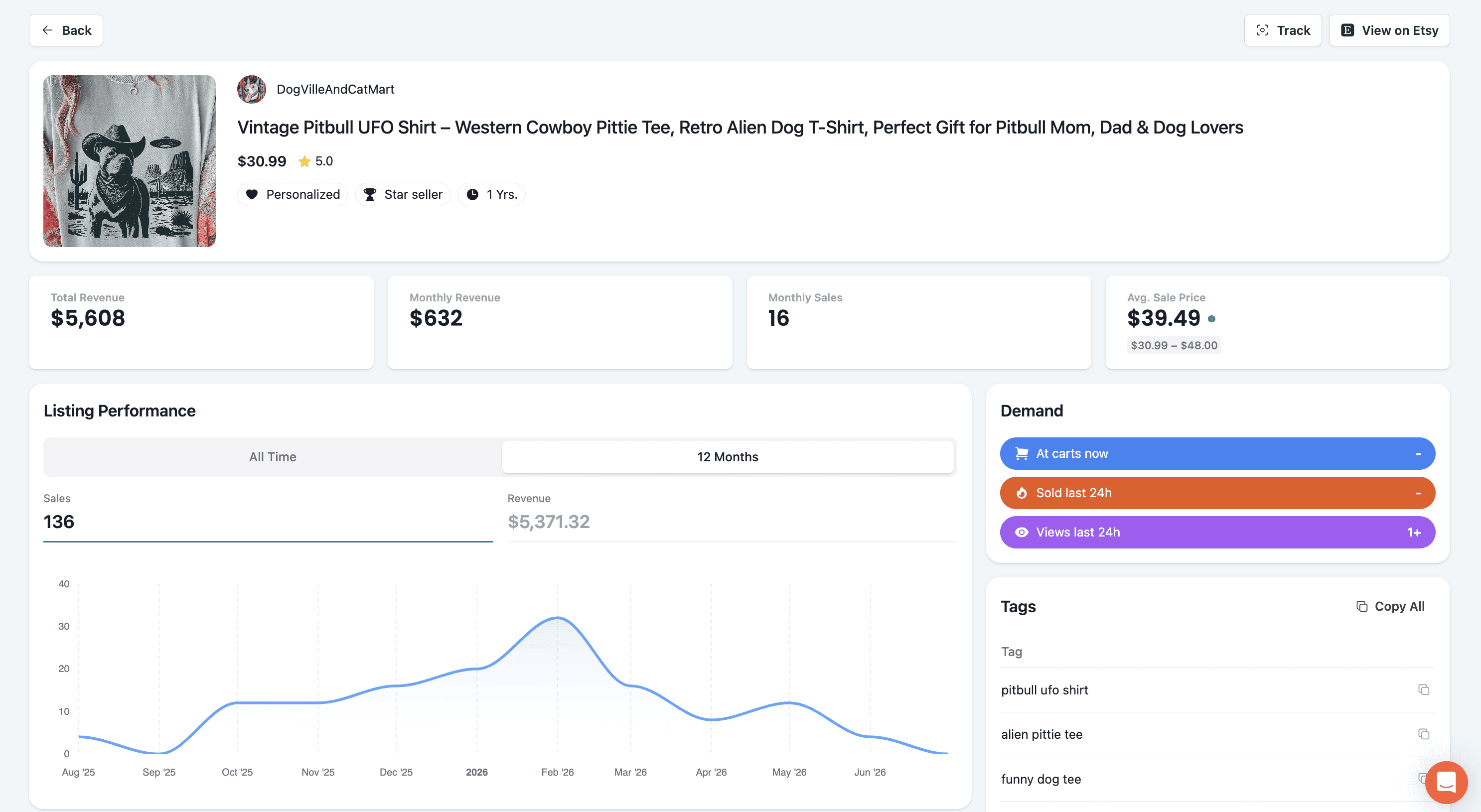
What's hot on Etsy, right now. A live feed of what's gaining traction lets you catch a niche while it's still opening up rather than after it's already saturated.
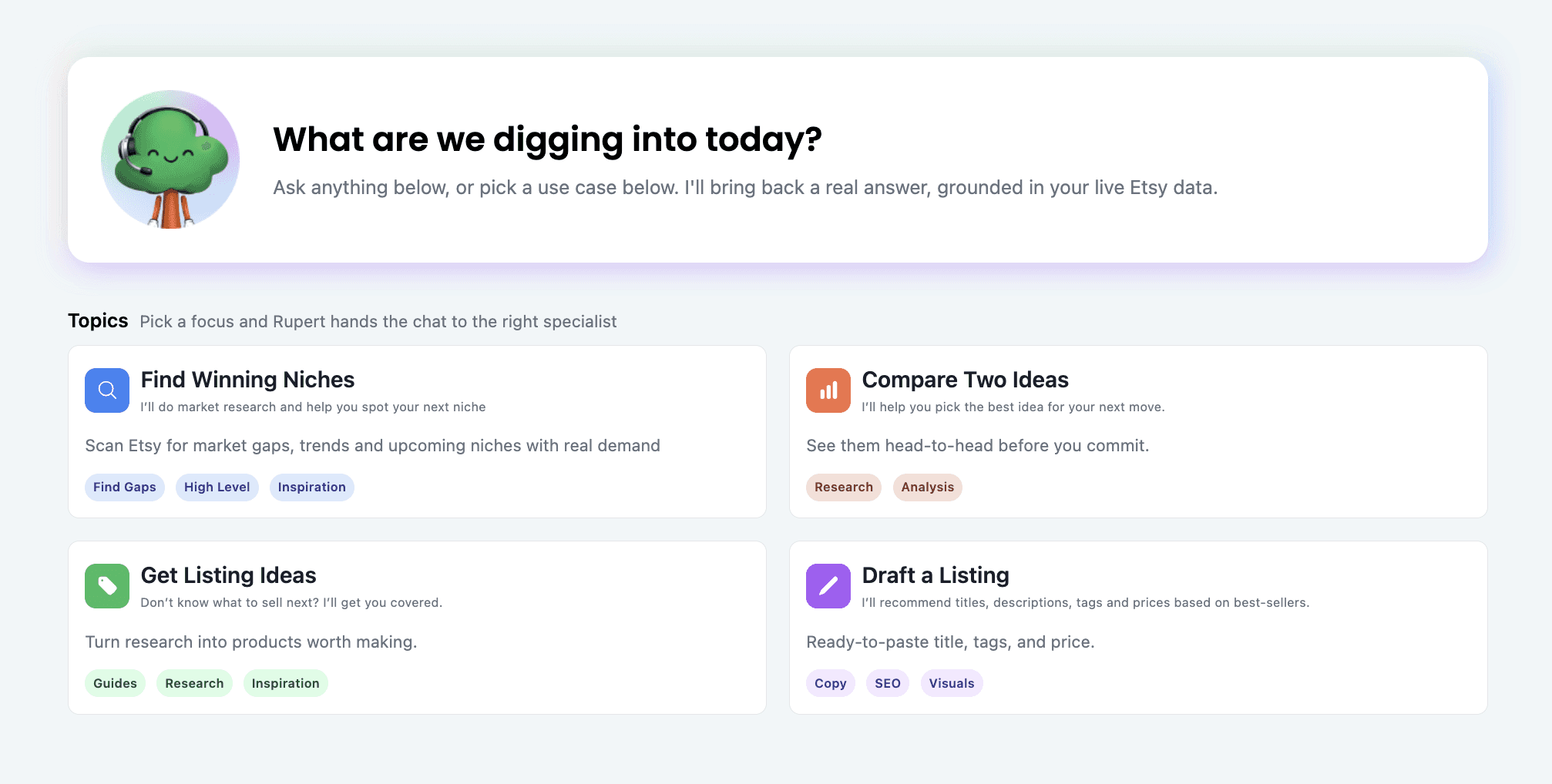
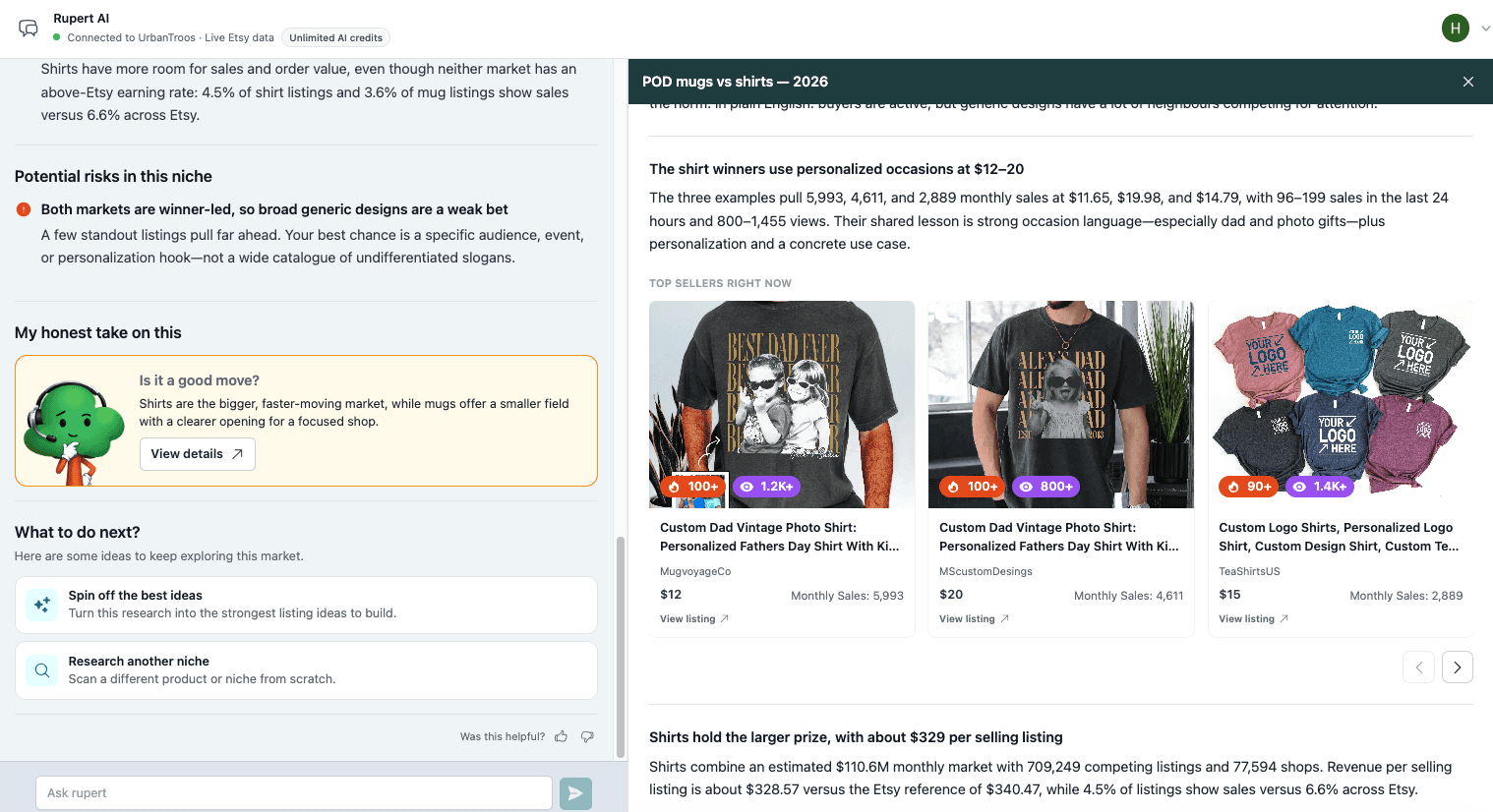
Rupert AI. You can ask Rupert to evaluate a niche idea directly — demand, competitors, market size, pricing, and risk — and get back a real answer grounded in Etsy data rather than a generic AI guess.
FAQ
What is a good niche score on Etsy? A strong niche score reflects meaningful buyer search volume combined with a low number of competing listings relative to that demand. There's no universal cutoff number — it's a relative comparison between niches, which is why a side-by-side scoring tool matters more than a single absolute metric.
How do I find low-competition Etsy niches? Look for niches where monthly search volume is healthy but the number of active competing listings is disproportionately low. Tools that show search volume and competition together (rather than a blended score with no visibility into the underlying numbers) make this easier to verify yourself.
Is eRank or ProfitTree better for finding untapped niches? eRank is strong for keyword-level research once you already know your niche. ProfitTree is built one step earlier in the process — evaluating whether a niche itself is worth entering — through its dedicated Niche Score. Many sellers use a niche-scoring tool to pick the space, then a keyword tool to optimize inside it.
Can AI actually find untapped Etsy niches? General-purpose AI tools (like asking ChatGPT for product ideas) tend to give the same popular suggestions to everyone who asks, which crowds the "untapped" niches quickly. AI tools built on live Etsy search and listing data — rather than general training data — are better positioned to surface niches that are actually underserved right now.
Does a low-competition niche always mean high profit? Not automatically. Low competition with very low search volume just means nobody wants it. The niches worth entering combine real demand with low competition — which is why a combined score is more useful than either metric alone.

