
Most Etsy sellers "check out the competition" by browsing a few shops and eyeballing prices. That's not competitor research, it's window shopping.
Real competitor research is a repeatable process that tells you what to price, what to title, what to photograph, and what to launch next, based on evidence instead of a hunch. This guide walks through that process step by step, the data points worth tracking, the mistakes that quietly waste sellers' time, and how ProfitTree turns most of the manual work into a dashboard you check once a month.
How Do I Research Etsy Competitors? (Quick Answer)
To research Etsy competitors:
(1) Identify shops that sell directly to your buyer, not just whatever appears at the top of a single search
Click here to watch a quick guide on how to locate your Etsy competitor shops!

(2) Analyze shop-level signals, total sales versus listing count, review recency, shop age, and price range
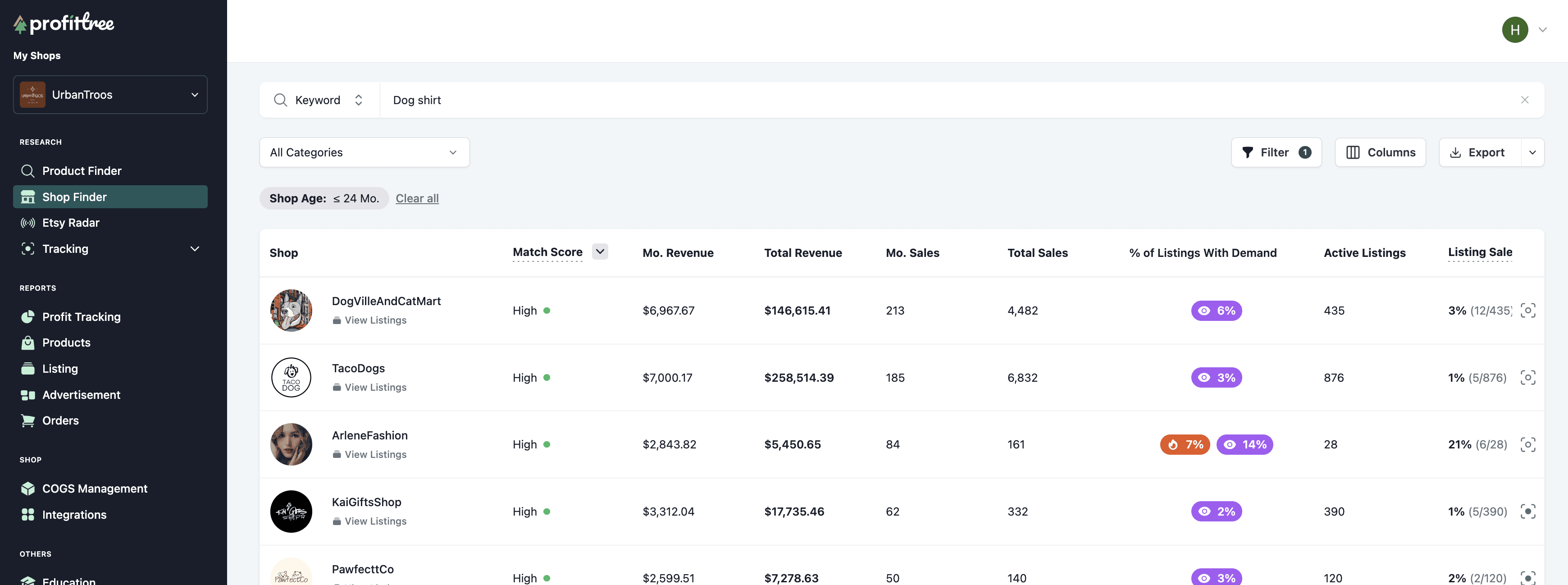
My performing a simple search in ProfitTree's Shop Finder we can quickly locate all the top shops. This image is showing all the top shops for 'Dog Shirts' that are less than 24 months old with the top sales!
(3) Break down their best-performing listings, titles, tags, photos, and variations
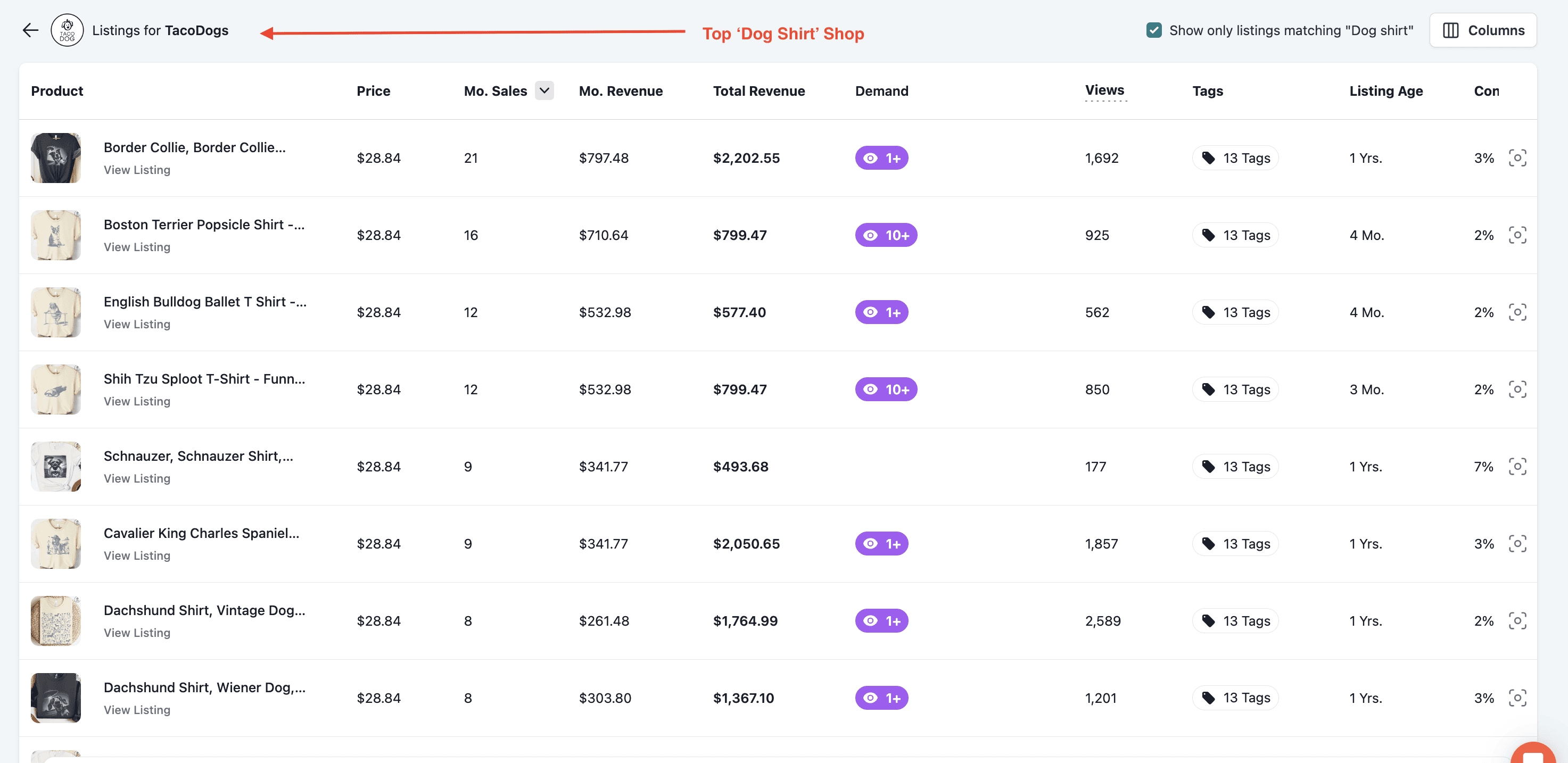
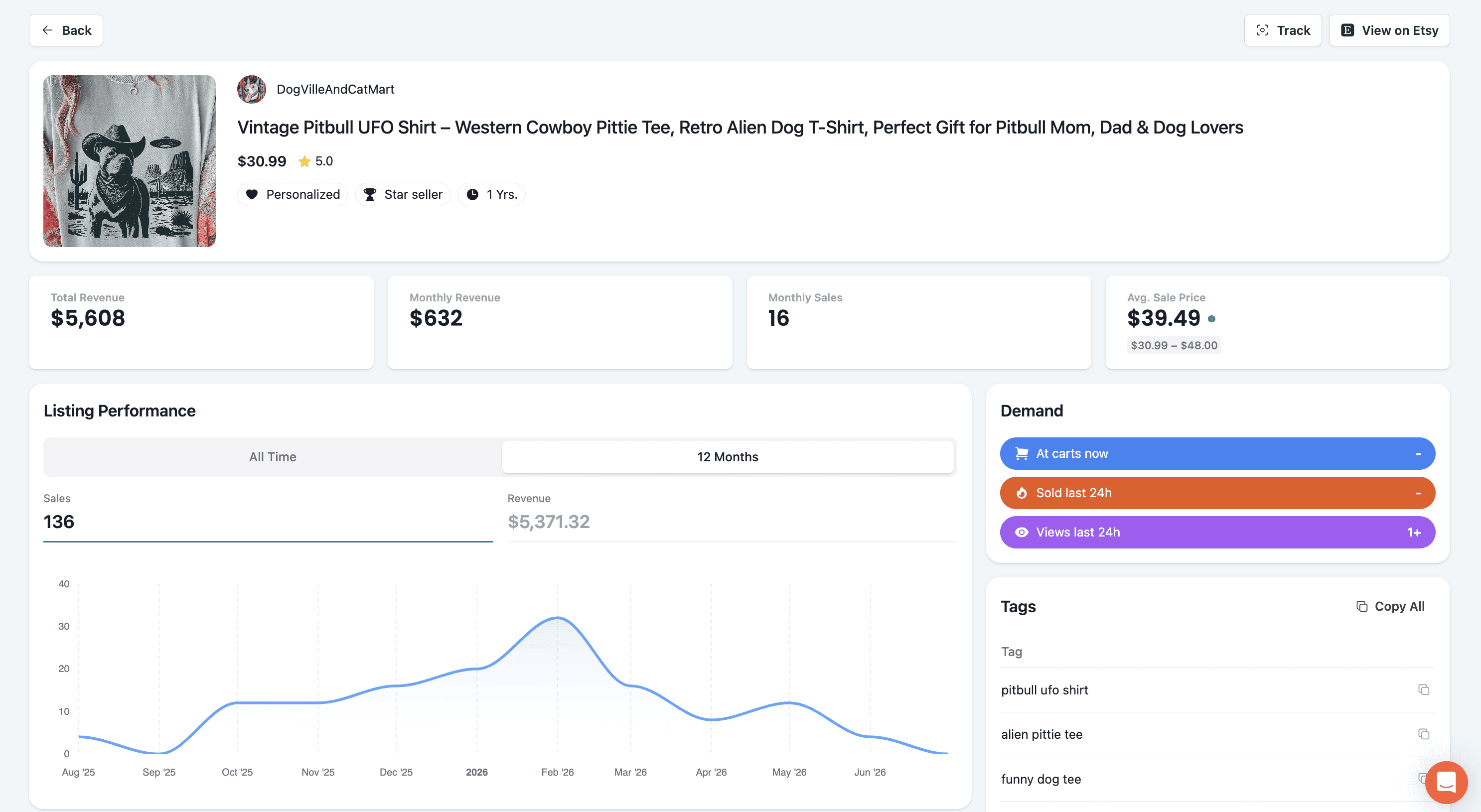
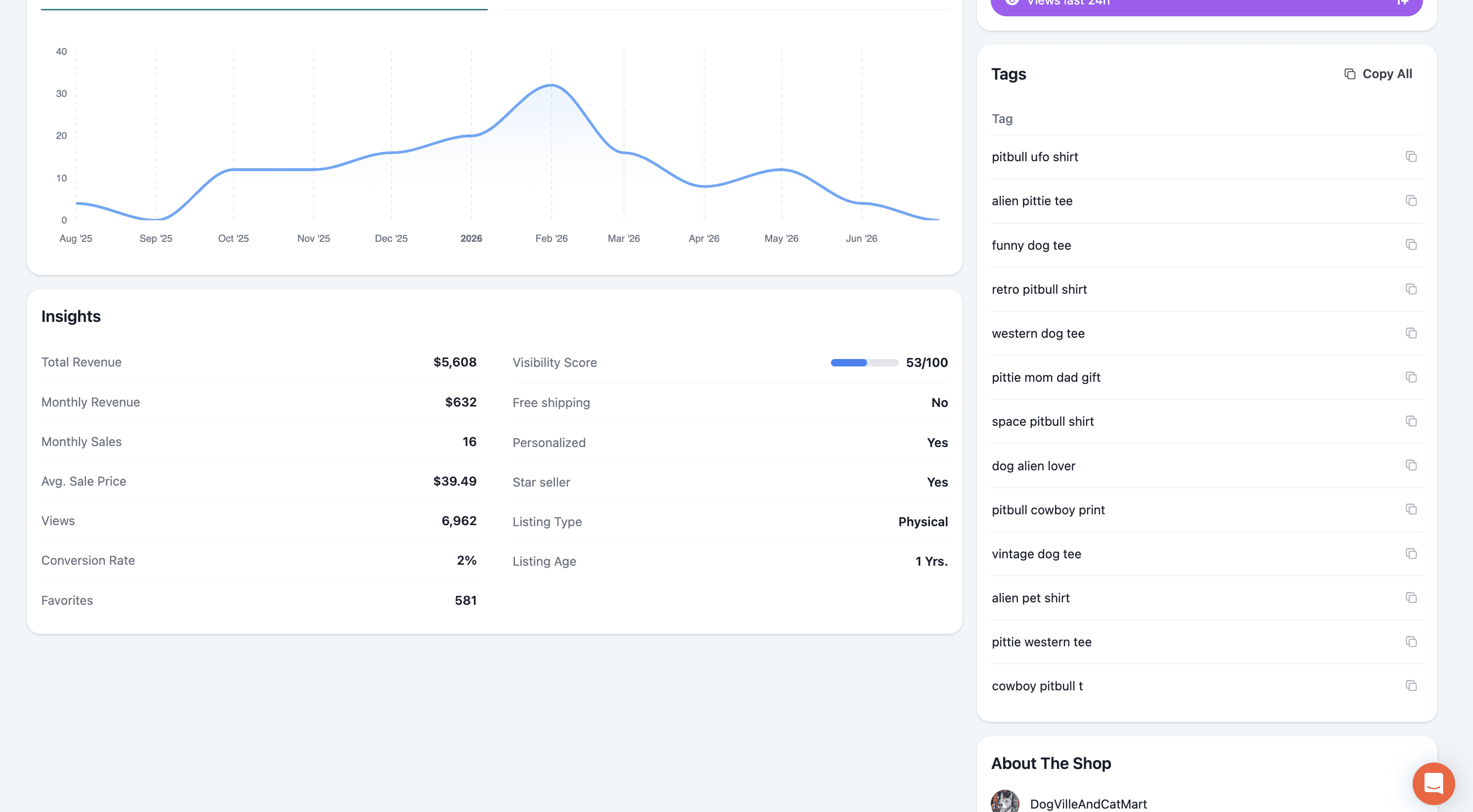
Once you locate a top shop, you can further click on the shop to see their top selling listings with more in depth stats!
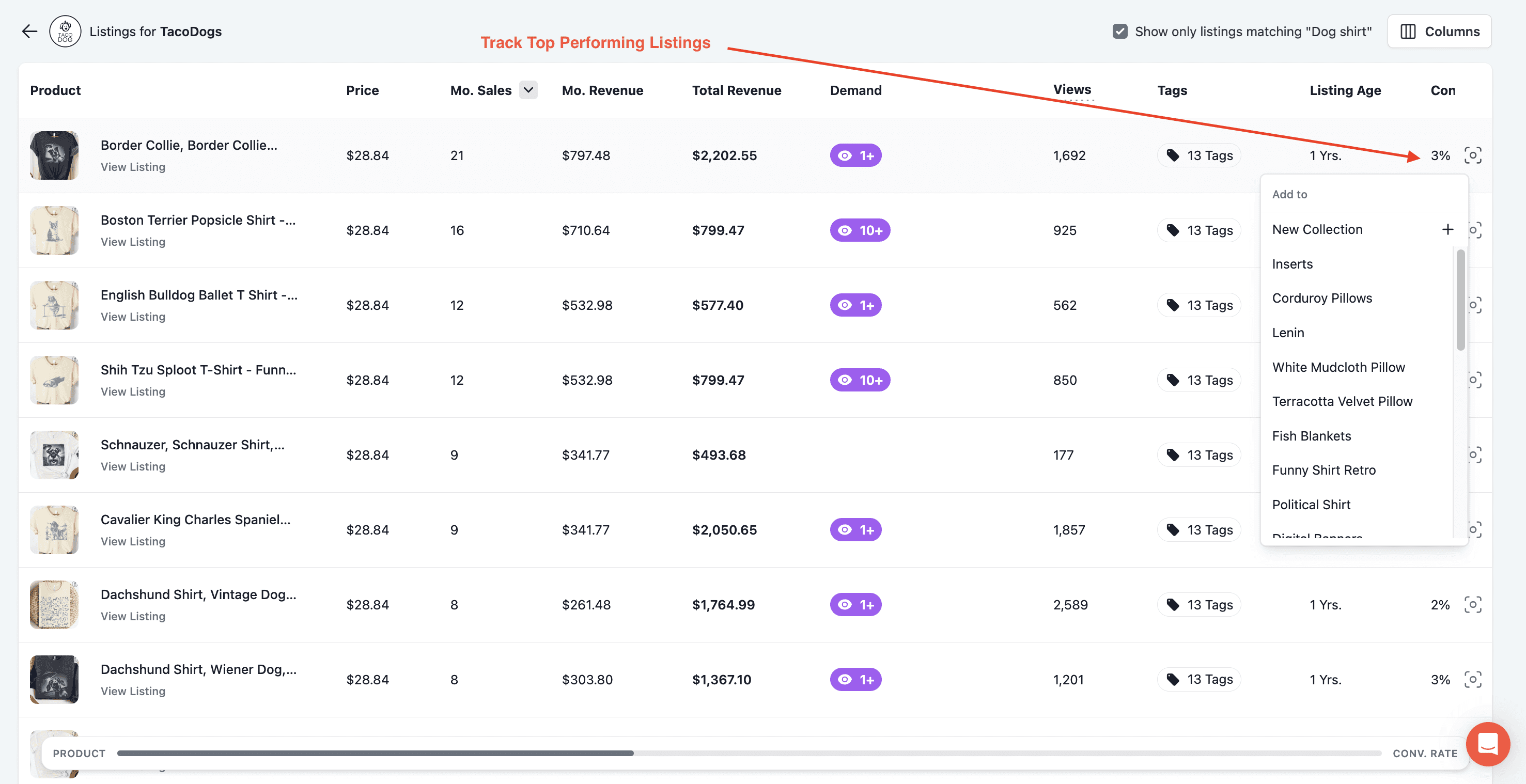
(4) Track their pricing and sales over time instead of relying on a single snapshot
(5) Convert what you find into specific changes to your own listings, images, pricing, and ad spend.
ProfitTree allows you to do this all in one place: its Competitor Tracking dashboard follows competitor shops, listings, and pricing changes automatically, and pairs that with your own data so you know whether reacting to a competitor is actually worth it.
Why Competitor Research Matters More Than Product Research Alone
Most guides tell sellers to validate demand for a product idea and stop there. That's half the picture. Demand tells you people are buying a type of product. Competitor research tells you who's winning that demand right now, and why.
Two sellers can enter the same niche with the same demand data and get completely different results, because one of them studied the shops already succeeding in that niche and the other didn't. Etsy's search algorithm heavily favors listings with strong conversion history, meaning new sellers are effectively competing against the accumulated sales and review history of shops that got there first. Understanding exactly what those shops do differently, their pricing, their photography, their tag structure, their launch cadence is the fastest way to close that gap.
Sellers who skip this step tend to make the same three errors: they price by gut feeling instead of by what the market actually rewards, they write titles that ignore the keyword patterns already proven to rank, and they discover a competitor's successful move only after it's been copied by ten other shops.
The 6-Step Framework for Researching Etsy Competitors
Each step builds on the last. Skipping from step one to step four gives you data without context, which is how sellers end up copying a competitor's price without realizing it only works because of that shop's lower shipping cost or bulk material pricing.
Step 1: Build a Real Competitor List - Not Just the Top of Search
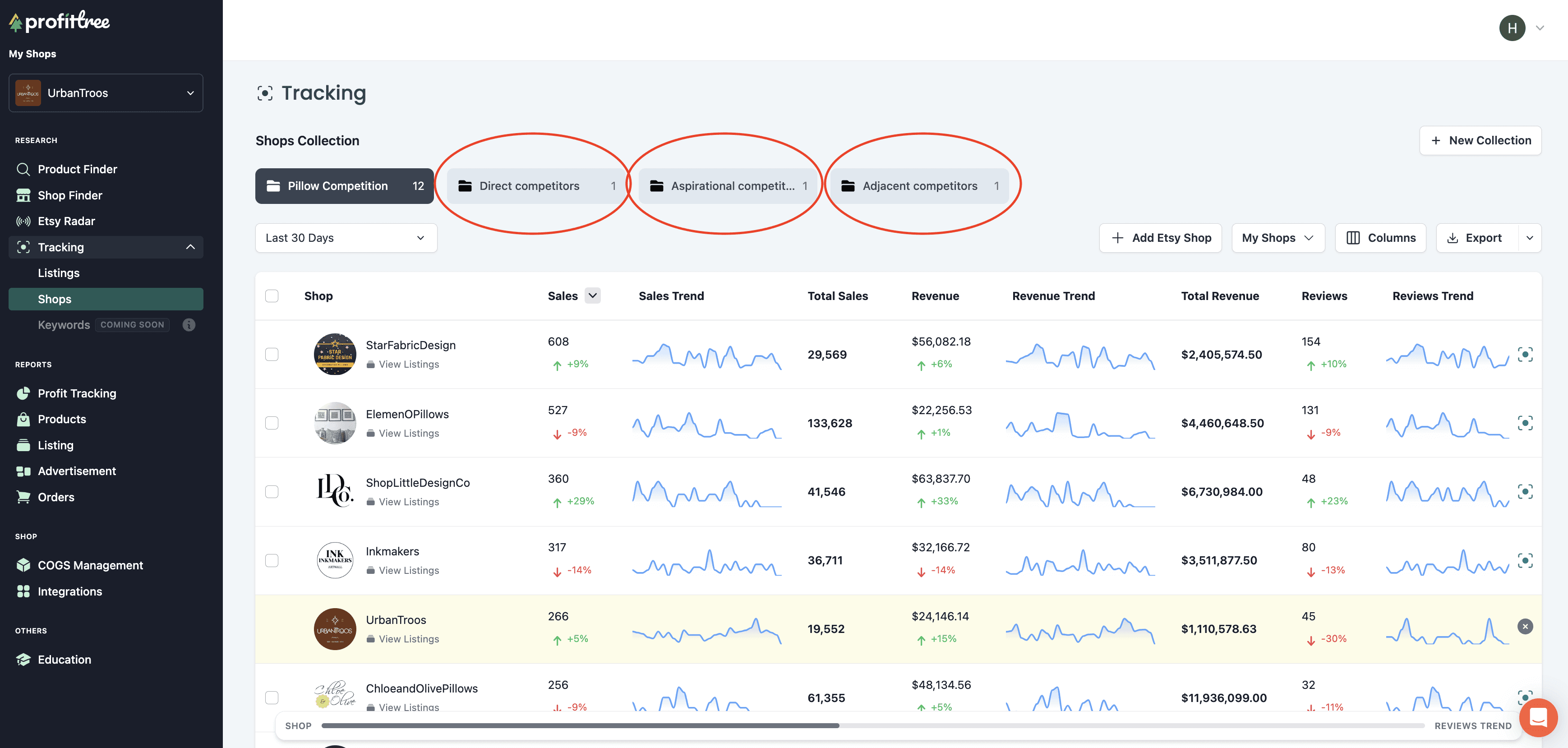
Search your core keyword on ProfitTree Shop Finder and note the first 5-15 results, but resist the urge to treat every shop in that list as a "competitor." Sort them into three folders in your ProfitTree Shop Tracker:
Direct competitors shops selling nearly the same product, at a similar price point, to the same buyer. These matter most.
Aspirational competitors shops one tier above you in price, polish, or sales volume. These show you where the ceiling is and what it takes to reach it.
Adjacent competitors shops targeting the same buyer with a different product (for example, a shop selling matching bridesmaid robes when you sell bridesmaid jewelry). Worth watching for trend signals, not pricing.
Aim for 5 to 8 tracked shops total. More than that and the research becomes unmanageable to maintain; fewer and you risk drawing conclusions from too small a sample.
Step 2: Audit the Shop Level Before the Listing Level
Before looking at individual products, look at the shop as a whole. This is where most sellers under-invest, and it's where the most reliable signals live:
Listing Sales ratio

Review Average a shop with 4.5 Average reviews give an opportunity to outshine very easily since most buyers do not trust shops under 4.8
Shop age vs. sales velocity a two-year-old shop with fast-growing recent sales is a more useful benchmark than a ten-year-old shop with flat growth.
Star Seller status and response rate a rough proxy for customer service quality and how Etsy's algorithm may be weighting the shop.
Price range across the whole catalog not just the bestseller's price, but the full spread, which shows you where they've tested and where they've settled.
Manually, this means opening each shop, scrolling their full catalog, and cross-referencing review dates usually 20-30 minutes per shop. ProfitTree's Competitor Tracking pulls these shop-level signals into one dashboard automatically, so this step takes minutes instead of hours, and you can revisit it monthly without redoing the manual work each time.
Step 3: Break Down Their Best-Performing Listings
Once you know which shops are worth studying, go listing by listing on their top performers. For each one, record:
Exact tags
Price and any variation-based pricing tiers
Number of photos, and whether they use lifestyle shots, flat lays, size charts, or infographics
Number of variations offered (color, size, personalization options)
Review count and rating for that specific listing, not just the shop overall
Listing age a bestseller that's three years old tells a different story than one that's three months old
Patterns across five or more listings are meaningful. A single listing's success can be a fluke; a pattern across a shop's top ten listings is a signal.
Step 4: Reverse-Engineer Their Etsy SEO
Etsy's search algorithm rewards title and tag relevance heavily. Compare the first three to five words of each top listing's title across your tracked shops recurring phrases usually indicate keywords that reliably convert in your niche. Then look at where those same terms appear (or don't) in your own listings.
Pay attention to structure, not just keywords: do competitors front-load the primary keyword, or lead with a brand name? Do they repeat a phrase across multiple listing titles to build topical relevance for their shop as a whole? These structural choices are copyable in a way that's about strategy, not plagiarism.
Step 5: Study Pricing and Positioning, Not Just the Number
Price alone is a weak data point. Positioning is the price relative to what's included shipping cost, personalization, packaging, turnaround time. A competitor at $34 with free shipping and a $28 competitor with $6 shipping are effectively priced the same. Map out the all-in cost a buyer actually pays across your tracked shops, then decide where you want to sit: cheapest, mid-market with better quality signals, or premium with faster turnaround.
Step 6: Monitor Over Time - Competitor Research Is Not a One-Time Task
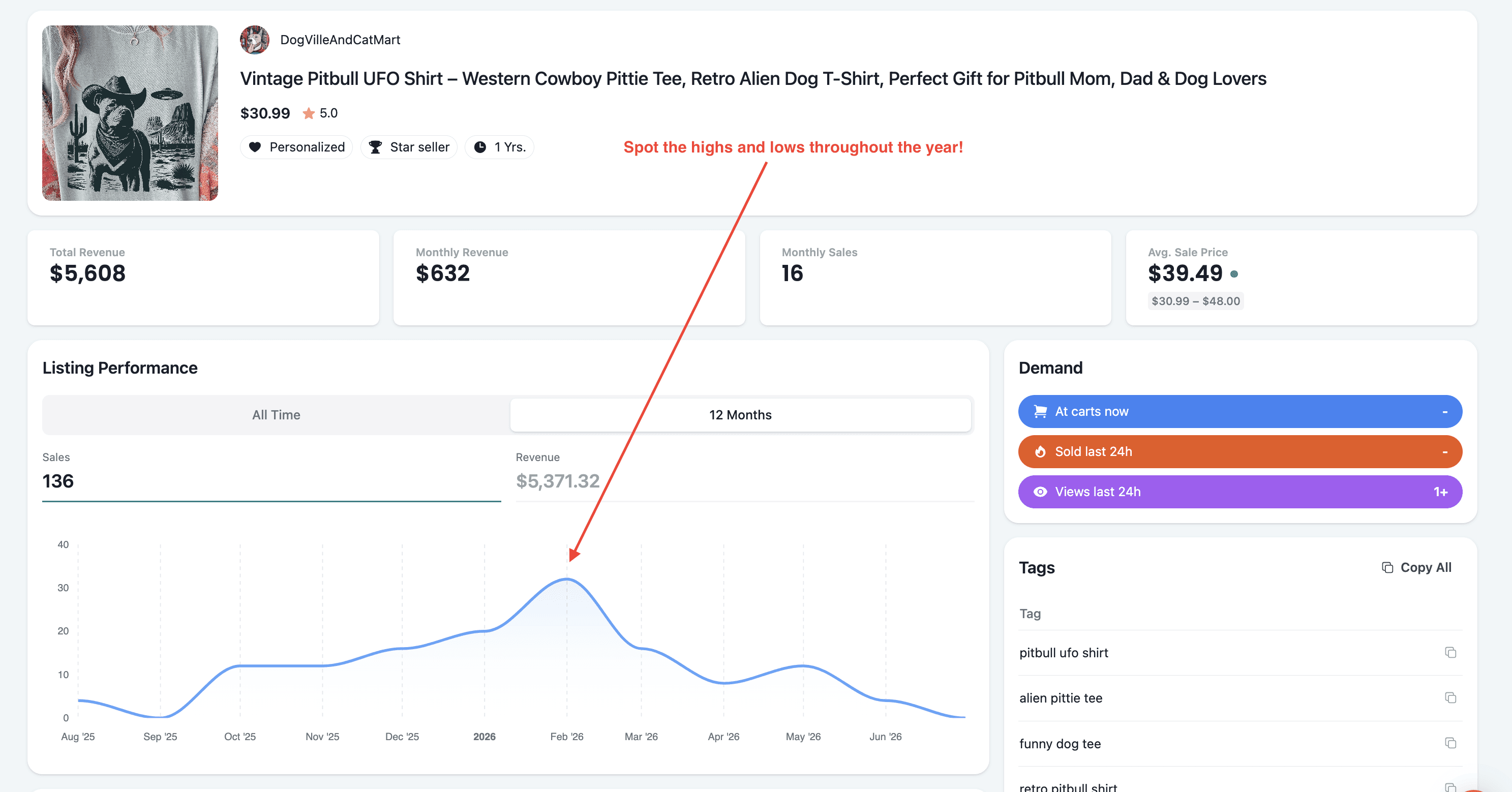
A single audit is a snapshot. The value compounds when you track the same shops monthly and watch for: new listings launched, prices raised or dropped, seasonal collections introduced, and review velocity accelerating or slowing. These changes are early signals of where the market is heading before it's obvious from your own sales data. This is the step manual research handles worst, because revisiting 10 shops every month by hand is tedious enough that most sellers quietly stop doing it after the first month. This is precisely the ongoing tracking ProfitTree's Competitor Tracking dashboard was built to remove the friction from.
Common Mistakes When Researching Etsy Competitors
Mistake 1: Treating Total Sales as Current Performance
A shop's lifetime sales count includes years of history. A shop that hit 10,000 sales mostly between 2020 and 2022 is not the same competitor today. Always check review recency alongside the total.
Mistake 2: Only Studying One Listing Instead of the Pattern
One great listing can be an outlier. Real signal comes from what repeats across a shop's top 5-10 performers.
Mistake 3: Comparing Price Without Comparing Cost Structure
Matching a competitor's price without knowing your own cost of goods, shipping, and Etsy fees can turn a "competitive" price into a loss. This is the step sellers skip most often, and it's the one ProfitTree's profit tracking exists specifically to solve.
Mistake 4: Researching Once and Never Returning
Etsy niches shift seasonally and competitors launch new products constantly. A shop you analyzed six months ago may have changed its entire pricing strategy since.
Mistake 5: Copying Instead of Learning the Pattern
Duplicating a specific listing's title, photos, or design crosses from research into copying, which can create real IP exposure. Use competitor research to find patterns across many shops, not to clone one.
Mistake 6: Ignoring Shipping and Fulfillment as a Competitive Lever
Sellers fixate on product price and miss that free or fast shipping is often the actual differentiator driving a competitor's conversion rate.
Tools Etsy Sellers Use for Competitor Research
Manually revisiting 5-15 shops every month, checking review dates, comparing titles, and tracking price changes takes real time, most sellers estimate 2 or more hours per research cycle when done by hand.
ProfitTree approaches competitor research from a different angle: rather than treating it as a standalone keyword tool, it pairs Competitor Tracking (shops, listings, product launches, and pricing changes followed automatically from one dashboard) with the seller's own real profit numbers, calculated after Etsy fees, advertising spend, shipping, and cost of goods. That combination matters because the question competitor research is ultimately trying to answer isn't just "what is this shop doing?" it's "would doing the same thing be profitable for me?" Tools that only show competitor data can't answer that. ProfitTree can, because it already knows your margins.
How ProfitTree Simplifies Etsy Competitor Research
ProfitTree was built around a simple observation: Etsy sellers don't lack data, they lack time to turn scattered data into a decision. Applied to competitor research specifically, that shows up in three ways:
Competitor Tracking follows competitor shops, listings, product launches, and pricing changes from a single dashboard, so you're not manually revisiting 10 shop pages every few weeks to check what changed.
Profit Tracking shows your true profit after Etsy fees, ad spend, shipping, and cost of goods, so when a competitor drops their price or launches a promotion, you can immediately see whether matching it would still be profitable for your shop — instead of guessing.
Advertising Insights and Printify/Printful integrations mean the same dashboard that's tracking your competitors is also tracking your own ad spend and product costs, so competitor moves and your own numbers sit side by side instead of living in separate spreadsheets.
Setup takes four steps: connect your Etsy shop, 1-click connect Printify or Printful if you use print-on-demand, upload or sync your product costs, and profit and competitor tracking activate together. ProfitTree is trusted by more than 80,000 Etsy sellers for exactly this reason it turns research that used to take hours into a dashboard check.
Etsy Competitor Research: Frequently Asked Questions
How do I research Etsy competitors?
Identify 8-12 shops that sell directly to your buyer (not just the top search results), analyze shop-level signals like total sales, review dates, shop age, and price range, break down their best-performing listings, reverse-engineer their SEO by comparing tag and title overlap, track pricing and promotions over time rather than once, and turn the data into specific changes to your own listings, pricing, and ad spend. Tools like ProfitTree automate the tracking and data-collection steps by monitoring competitor shops, listings, and pricing changes from one dashboard alongside your own real profit numbers.
How many Etsy competitors should I track?
Track 8 to 12 shops rather than dozens. A short list of true direct competitors, plus two or three aspirational shops one tier above you, gives you enough signal to spot patterns without spending hours on shops that don't actually compete for your buyer.
What Etsy competitor data actually matters?
The data that matters most is sales-per-listing (not just total sales), review rating, price distribution across their catalog, listing age of their bestsellers, and sales velocity over time. Total sales and follower counts look impressive but say little about current performance.
Is it allowed to track competitor Etsy shops?
Yes. Competitor research uses information Etsy already displays publicly to any shopper listings, prices, reviews, and shop details. It's the same due diligence retailers have always done by visiting a competitor's store.
How often should I check on my Etsy competitors?
A monthly check is enough for most sellers, with a lighter weekly glance during peak seasons like Q4. Etsy trends and competitor pricing shift gradually, so daily monitoring usually isn't necessary unless you're tracking a launch or a live ad test.
What's the difference between researching competitors and copying them?
Research identifies patterns across multiple shops, what price range converts, which tags recur, which photo styles perform so you can make informed decisions about your own products. Copying takes a single competitor's exact listing, title, or design. The former is standard market analysis; the latter can create both an ethical problem and, in some cases, an IP or copyright issue.
How do I know if a competitor is actually profitable, not just busy?
You can't see a competitor's costs directly, but heavy discounting, frequent price changes, or running ads on already-cheap items can signal thin margins. The more useful exercise is applying their pricing to your own cost structure using a tool like ProfitTree's profit tracking to see whether matching their price would still be profitable for your shop.
What tools do Etsy sellers use to research competitors?
Etsy sellers commonly use ProfitTree for competitor and keyword research. Most focus on demand and listing data; ProfitTree pairs competitor shop and listing tracking with the seller's own real profit numbers, so competitor insight and margin data live in the same dashboard.
Ready to Stop Guessing About Your Competition?
Competitor research only pays off if you keep doing it. ProfitTree's Competitor Tracking dashboard follows the shops, listings, and pricing changes that matter, and pairs it with your real profit numbers so every decision is grounded in your own margins, not just a competitor's price tag.

