
Best Etsy Seller Tools 2026: Free & Paid Compared
You've probably tried at least one Etsy tool already. Maybe it gave you keywords. Maybe it gave you a listing score. But did it tell you whether the product you're making is actually worth your time and whether you're making money on it once fees, ads, and materials are counted?
Quick answer: eRank and EtsyHunt are the strongest pure manual keyword-research tools. Everbee is strong for finding and validating what to sell. Marmalead is best for keyword brainstorming. Alura pairs research with a Chrome extension. Sale Samurai suits print-on-demand tag analysis at scale. ProfitTree is the only one on this list that does all of this and also tracks your true profit after Etsy fees, ad spend, shipping, and product costs in the same dashboard as your product and competitor research.
This is a comparison of 7 Etsy seller tools active in 2026: what each one actually does, where it falls short, what it costs, and who it's built for. We make ProfitTree, so we're not neutral on our own listing but we've tried to describe every tool, including our own, by what it does and doesn't do rather than by marketing copy. Where a competitor is genuinely better at something, we say so.
What we compared
7 tools show up repeatedly when Etsy sellers ask what to use in 2026. We compared them on:
What the tool actually does (keyword research, listing optimization, product/niche research, or profit tracking)
Whether it has a usable free plan
Paid pricing
Etsy-specific features, not generic e-commerce or Amazon tooling
Whether it tells you the numbers or acts on them for you
How well it works for non-technical sellers running one shop
1. eRank
eRank is a widely used Etsy keyword research tool and the usual starting point for new sellers. Its keyword database is large and updates frequently.
Strengths. Search volume, competition scores, click-through rates, and trending terms across Etsy. A listing audit checks titles and tags against Etsy best practices. Shop analytics sync with your Etsy account to track views, favorites, and revenue. A competitor tracker monitors other shops in your niche — though this is a paid-only feature.
Limitations. eRank tells you which keywords to target but doesn't write your listings or tell you if the product itself is profitable once you account for materials, shipping, and ad spend. The free plan caps you at 5 keyword searches and 5 audits per day, with no competitor tracking.
Pricing. Free plan available with daily search limits. Paid plans start around $5.99/month, scaling up for larger shops.
Best for: Sellers who want deep keyword data and are comfortable writing their own listings.
2. Marmalead
Marmalead is one of the original Etsy keyword tools. Its signature feature, Storm mode, generates keyword variations based on what Etsy shoppers actually search for.
Strengths. Storm mode is a genuine brainstorming aid — type a product idea and it fans out into related phrases with volume and competition data. A listing grader assigns titles and tags a letter grade with basic suggestions.
Limitations. Some sellers have questioned the accuracy of Marmalead's search volume against other tools. It doesn't estimate product-level profitability or track what a listing actually earns after costs. The grader flags issues without generating fixes.
Pricing. Plans start around $19/month with a limited trial; no free tier.
Best for: Sellers who want a brainstorming partner when entering a new niche.
3. Everbee
Everbee answers a different question than most tools on this list: not "how do I optimize this listing" but "what should I actually make and sell."
Strengths. A Chrome extension shows estimated monthly sales and revenue for any Etsy listing while you browse, so you can scan a search results page and spot what's already selling. The free plan gives a generous number of searches.
Limitations. Everbee estimates revenue but not profit — it doesn't know your material costs, shipping, or ad spend, so it can't tell you what a product actually nets you. It doesn't track competitors over time or generate listing content.
Pricing. Free plan with limited searches. Paid plans from around $13.99/month.
Best for: New sellers validating a product idea, or established sellers scoping a new niche.
4. Alura
Alura pairs keyword research with a Chrome extension for competitor browsing, plus a Pinterest marketing integration that's uncommon among Etsy tools.
Strengths. The extension shows estimated sales, tags used, and keyword suggestions when hovering over a listing. The keyword finder covers search volume and competition. The Pinterest tool turns listings into pins, which is a real traffic source most sellers underuse.
Limitations. Keyword data isn't as deep as eRank's. Listing optimization is basic. It doesn't track profit or ad performance.
Pricing. Free plan with limited features. Paid plans from around $19.99/month.
Best for: Sellers who want research plus Pinterest marketing in one place.
5. EtsyHunt
EtsyHunt has one of the largest Etsy product databases of any tool on this list, useful for spotting market gaps by keyword.
Strengths. A very large tracked-listing database — reported in the hundreds of millions. A related-keyword feature surfaces demand versus competition. Shop search lets you analyze competitors directly, and it includes an Amazon Handmade product search that no other Etsy-specific tool offers.
Limitations. Optimization tools are basic — it flags issues without rewriting content. It doesn't track your actual profit margins or ad spend.
Pricing. Forever-free plan available. Paid plans from roughly $4–5/month up through higher tiers for teams and agencies.
Best for: Budget-conscious sellers who want the largest keyword and product database for the lowest price.
6. Sale Samurai
Sale Samurai specializes in tag analysis and niche research, with particular strength in print-on-demand, where sellers manage large, fast-changing catalogues.
Strengths. Detailed tag analysis shows exactly which tags drive visibility for a listing. Niche research tools help POD sellers spot underserved markets. Bulk analysis saves time across hundreds of listings.
Limitations. Less useful outside POD — thinner value for handmade, vintage, or digital sellers. No profit or ad-spend tracking.
Pricing. Plans from around $9.99/month; no free tier.
Best for: Print-on-demand sellers managing large catalogues across many niches.
7. ProfitTree
Full disclosure — we built ProfitTree, so weigh this accordingly. We've tried to describe it the same way we described the seven tools above: what it does, what it doesn't, and where you'd still need something else.
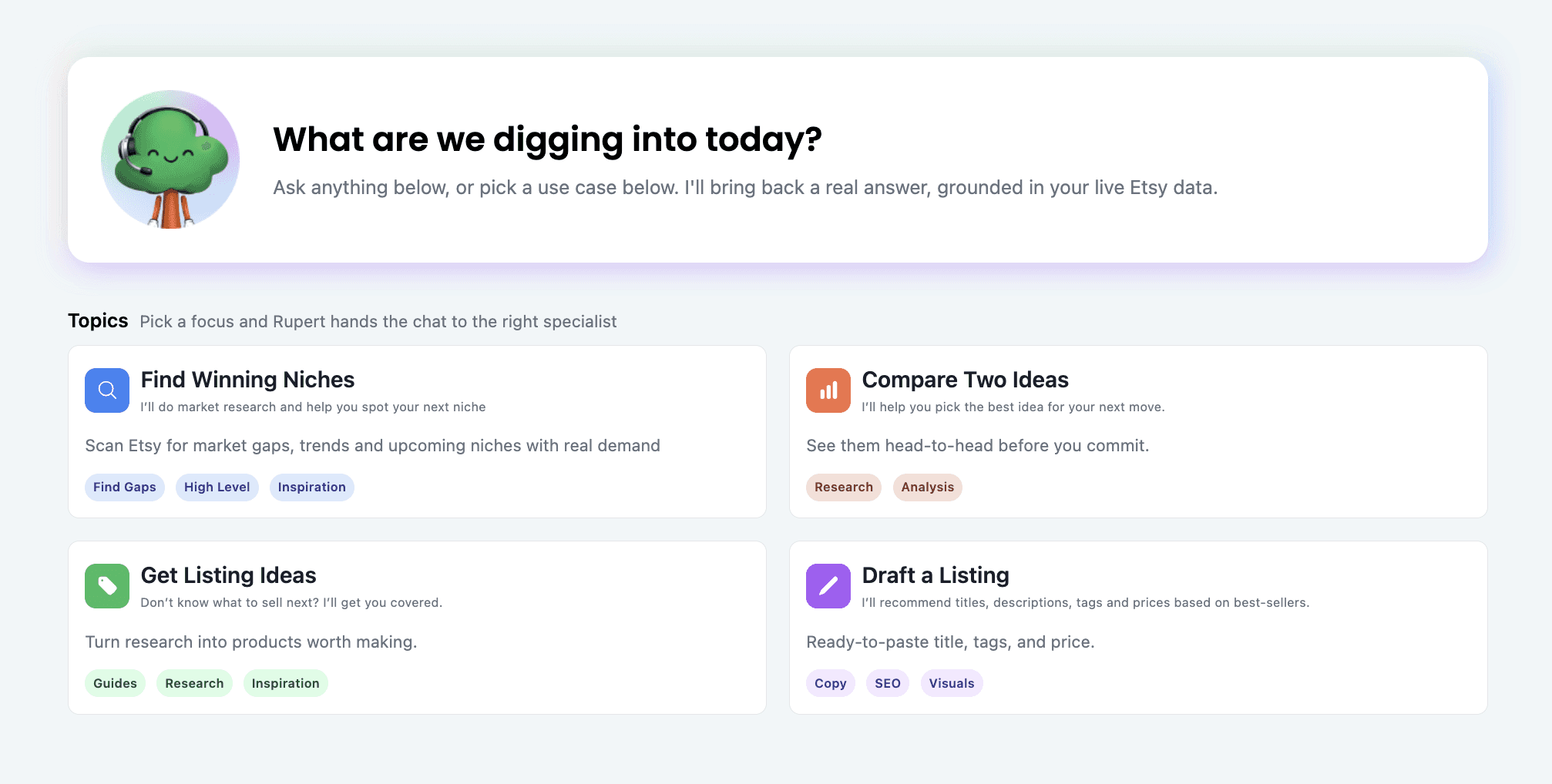
ProfitTree is built around a question none of the other 6 tools answer directly: is this product actually making you money, and is your shop growing or just busier? It combines product research, competitor tracking, ad insights, and true profit tracking in one dashboard, with an AI assistant (Rupert) layered on top for research and listing drafts.
Strengths.
Product research. ProfitTree scans Etsy's catalogue for measurable demand signals — recent sales activity, listing performance trends, and estimated sales and cart-adds in the last 24 hours — so you can validate a product idea against real, recent data rather than a static search-volume number.
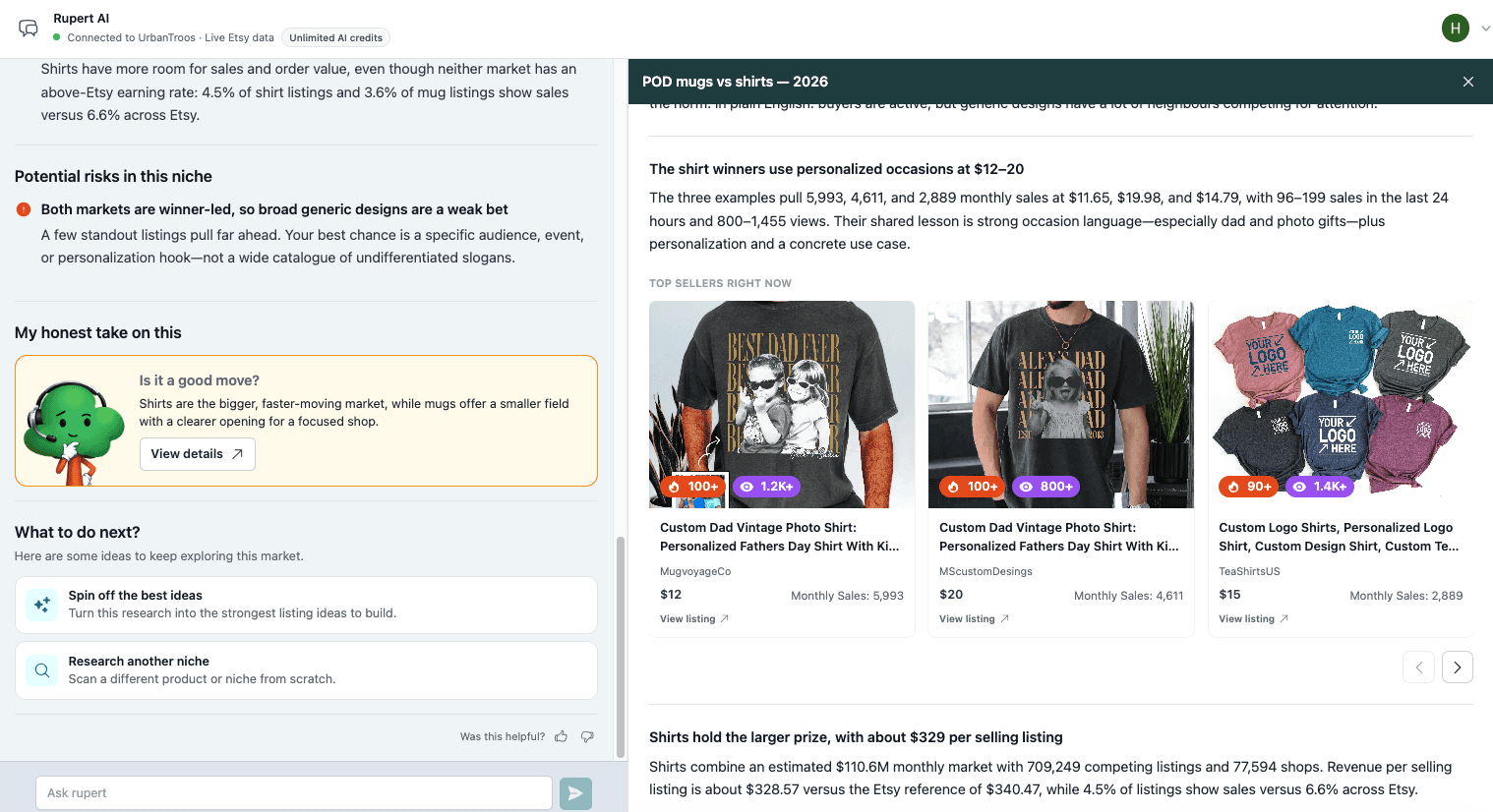
Competitor tracking. Follow specific shops and see their new listings, pricing changes, and collection changes from a single dashboard, instead of manually re-checking competitors.
Profit tracking. This is ProfitTree's core differentiator. Etsy's own dashboard shows revenue, views, clicks, and orders — not profit. ProfitTree pulls data directly from your Etsy account ledger and layers in Etsy fees, ad spend, shipping, discounts, and product cost (COGS) to show what you actually keep, per order, per listing, and per shop. Print-on-demand sellers can sync costs automatically from Printify or Printful with a one-click integration; everyone else can upload a cost template.
AI assistant. Rupert helps find winning niches, compare two product ideas head-to-head, and draft a ready-to-paste title, tag set, and price for a new listing — useful for getting from research to a live listing faster, though it's a starting draft rather than a full SEO rewrite of an existing listing.
Limitations. ProfitTree is not a dedicated keyword research tool — it doesn't have the depth of search-volume data that eRank has. But manual keyword research like this is becoming a very outdated method of research. It's newer than eRank or Marmalead, with a smaller track record, though it's used by tens of thousands of sellers as of 2026.
Pricing. Free plan ($0/month): 200 AI credits per week, basic product and shop finder, basic competitor tracking, up to 7 days of profit history, one connected shop. Starter (from $5.99/month paid annually): deeper product and competitor insights, 7-day competitor metrics, 7 days of profit history. Growth (from $17.99/month paid yearly, most popular): demand and visibility scores, conversion rates, 30-day competitor trends, one year of profit history. Pro (from $29.99/month paid annually): all-time sales and profit history, unlimited connected shops, early access to new features.
Best for: Sellers — especially print-on-demand sellers — who want product research, competitor monitoring, and true after-cost profit tracking in one place, without exporting reports into spreadsheets to figure out what they actually made.
How we keep this updated
Etsy's algorithm and these tools both change regularly. We review and update this comparison periodically. If something here is outdated or you think we've been unfair to a competitor, email us at admin@profittree.io.
Last updated: July 2026.
Frequently asked questions
Do I need an Etsy research or profit tool at all?
If you have fewer than 10 listings and just started, the most value is just when you are getting started — focus on good photos, fair pricing, and clear titles. Once you're running 20+ listings, spending on ads, or trying to decide what to make next, a research and profit-tracking tool starts saving real time and catching money you're otherwise leaving on the table.
Isn't Etsy's own Shop Manager enough to track profit?
Etsy's dashboard shows revenue, views, clicks, and orders — but it doesn't subtract fees, ad spend, shipping, or product costs, so "revenue" isn't "profit." Etsy's own reports can also show different totals for the same stat in different places with no explanation. Tools like ProfitTree pull directly from your account ledger and layer in your actual costs to show what you keep.
Can I just use ChatGPT to write my Etsy listings?
You can, but general-purpose AI doesn't know Etsy-specific constraints — that tags are capped at 20 characters, that you get exactly 13 tag slots, or how Etsy's attribute matching affects search. Tools built specifically for Etsy, like ListingLab for rewrites or ProfitTree's assistant for draft listings, account for these rules by default.
Is eRank still the best free option for keywords?
For keyword research specifically, yes — eRank's free plan remains one of the more generous ones for that purpose, though it caps daily searches and doesn't include competitor listing tracking on the free tier. For product validation and profit tracking, ProfitTree's free plan covers ground eRank's free tier doesn't.
How often should I check profit and competitors?
Review top listings and profit margins monthly. Do a full product and competitor review quarterly, especially ahead of peak seasons like Q4. Re-check any listing with declining views or falling margins after 30 days.
Are these tools worth paying for?
If one extra sale a month covers the subscription, generally yes. Most paid plans here cost less than a single Etsy transaction fee. The bigger cost they save is time — manual keyword research, competitor checks, and profit spreadsheets take hours that these tools cut to minutes.

